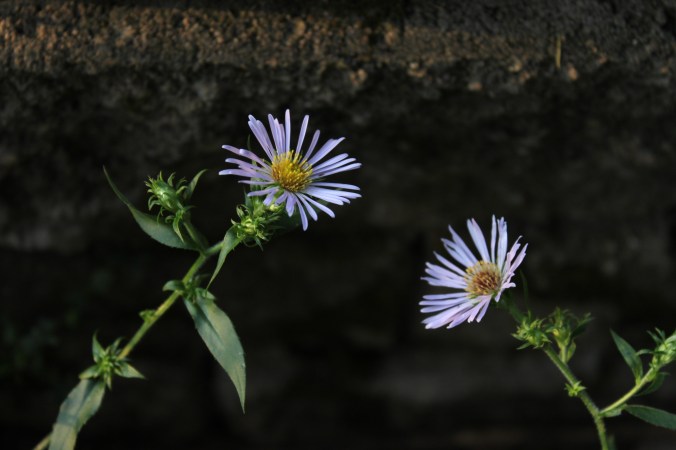
Weekly Homestead Report 10: Oct 17, 2016

As we try to keep our anxiety about the upcoming election at bay, it is good to be able to walk in the woods and notice flowers.

Indian tobacco, Lobelia inflata, is blooming again, although it already has mature seeds.

Maple leaf viburnum, Viburnum acerifolium, has ripe fruits. Charley says that they’re technically edible but not worth it.

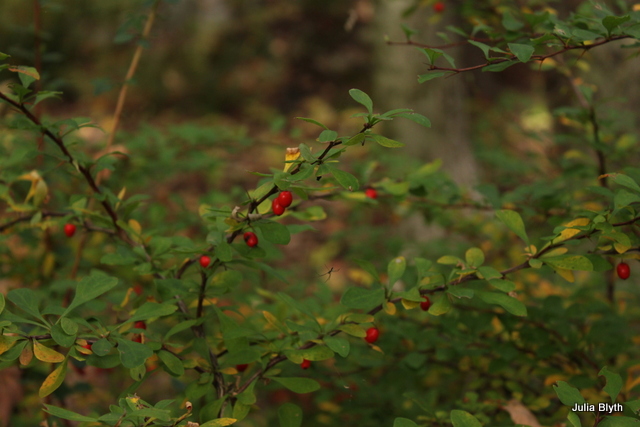
Japanese barberry, Berberis thunbergii, is (regrettably) also fruiting. Not prepared with gloves, we pricked our fingers pulling up barberry on a walk off of our usual trail where we’ve pulled most of the invasive plants already. Japanese barberry is one of our least favorite invasive plants because of its spines and the fact that it readily sprouts from seeds that the robins poop (along with multiflora rose and bittersweet).

img_7005

This was the week of the first frost (10/14) and the first fire (10/16).

Well, it wasn’t really that frosty, but I didn’t get a photo before it was gone, so I found one from last year. We covered our strawberries and raspberries with sheets, and they still seem to be in good shape.

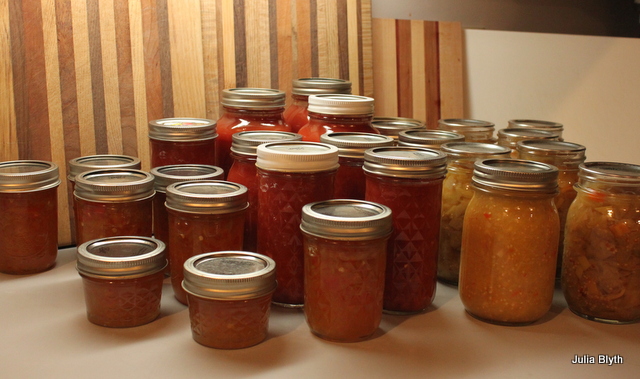
Of course the frost meant that we went out the day before to rescue the last of the tomatoes, tomatillos, and peppers… thus more hot pepper jelly, tomatillo salsa, and a batch of enchilada sauce.

img_7146

One of our older hens died, so I put the carcass out in front of the wildlife camera. We were able to add a new mammal species to our yard list for the first time in a year or so: grey fox! We also got photos of a red fox, a coyote, and a couple raccoons.

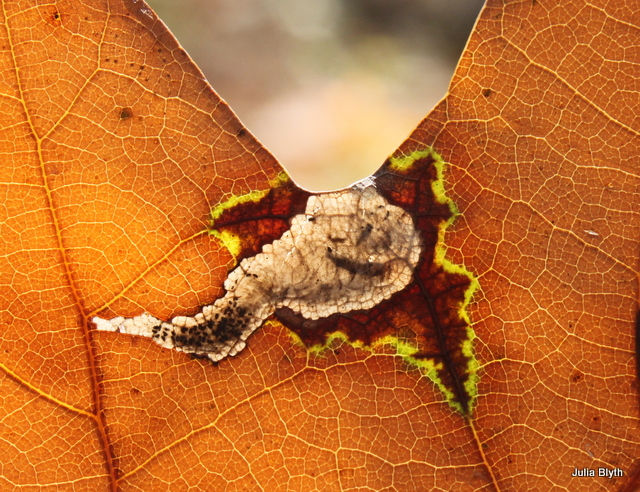
In honor of Charley, and because we led an insect tracking walk today, I give you Coptotriche fuscomarginella (or possibly a closely related species). It’s the leaf mine and larva of a moth in the family Tischeriidae. What a beauty!

img_7051


Weekly Homestead Report 9: October 10, 2016

Pictured here: fall’s finest bird food (poison ivy) and aster eye candy! This week a number of longstanding items got crossed off of our big to-do list, and in the process, we learned important lessons about timing harvests.

  • sweep chimney (nothing too bad, here)
  • dig potatoes (grrrrr! voles!)
  • pick and shell dry beans (oh, no! mold!)
  • pick popcorn (oh no, mold again! But not too bad.)
  • harvest remaining watermelon (gah! overripe!)

The dry beans seemed to be doing well last time I checked, but the last two weeks of wet weather caused some of them to get moldy instead of dry. I’ve been doing a rescue operation to try to salvage most of them. I could have picked the whole plants and hung them in the shed to dry, giving up the possibility of the younger pods ripening, but thoroughly drying those that had already made beans. Instead, I’ve been shelling not-quite dry beans, throwing out the ones that are slimy or moldy. There are still a bunch in the field that aren’t ready, but some weeding and propping up collapsed plants to allow greater air flow makes me think they’ll successfully dry on the vine. Lessons for next year…

Digging the potatoes really made me mad, because about 2/3 of the potatoes are damaged—some almost completely eaten—by voles.  Voles seem to be one of our main garden pests. We’re out there all winter shoveling the snow away from our fruit trees so it doesn’t top our hardware-cloth vole guards (they would happily eat all the bark they can get to under the snow, thereby girdling our trees). Next year, I will try to harvest potatoes early to mid September when the vines die back instead of waiting until October to harvest. My strategy was to “store” them where they were, to minimize their time in my root cellar, hopefully maximizing the length of time they would last before trying to sprout. If waiting allows the doggone voles eat them before I even get to them, though, that’s far worse than knocking a few sprouts off and eating slightly squishy (but intact!!) potatoes in March.

When I picked the first ear of dry popcorn, I panicked to find a tiny amount of mold… but it was just on a few ears, luckily. I spent an hour in the afternoon shucking the corn and crafting corn husk dolls to distribute to some of the kiddos in my life. This was satisfying.

When we picked the watermelons in anticipation of another frost tonight, we found that we had waited too long on some of them, and they centers around the seeds had deteriorated beyond enjoyment. This is truly a tragedy.

Because the Nantucket Conservation Foundation is hosting its annual cranberry festival this weekend, we decided it must be time to eat ours. Delicious!

We noticed some doll’s eyes, the creepy fruit of white baneberry, Actaea pachypoda. 

As for the chimney sweeping, it was a good opportunity to view the yard from on high.


Weekly Homestead Report 8: October 3, 2016

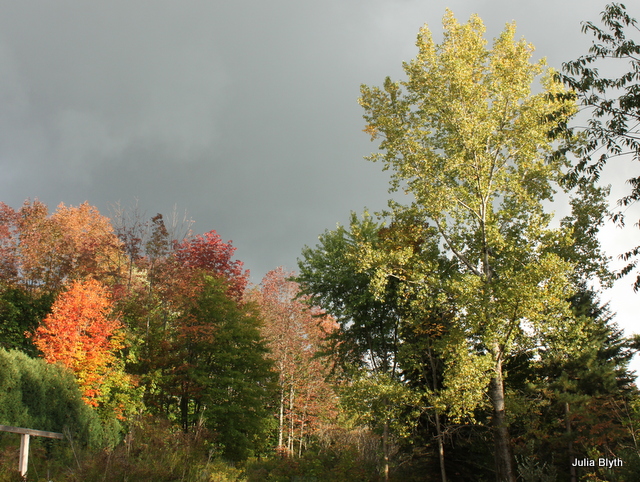
Dreary skies have made it difficult to appreciate the vibrant colors of the leaves, but they’re real nice. Today the sky finally cleared for a few hours, and then a huge dark cloud blew over and dumped a bunch of rain on us in the late afternoon.

img_6709

The tomato vines are starting to look a bit brown, but we’re still overrun by tomatoes, peppers, eggplants, and tomatillos. We just made some eggplant Parmesan to keep things under control. My food preservation efforts are starting to feel a lot less fun. For inspiration, I called up Jeannie Seabrook, a good friend who owns the Glass Rooster Cannery. She gave me a bunch of new recipes, so hopefully the next round will be more interesting.

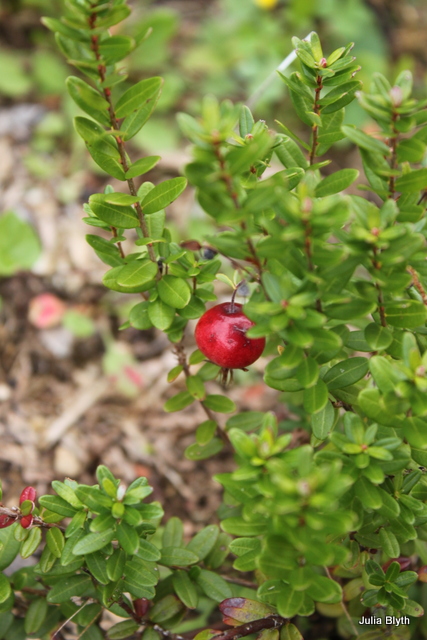
We’re trying to grow every edible plant we can think of, including some that prefer conditions other than those we can offer. Cranberries fall into this category, since they thrive in bogs. This year one of our two cranberry plants fruited, and the berries are nearly ripe!

img_6462

One of our hens laid a rubbery egg without a proper shell. We ate it anyway.

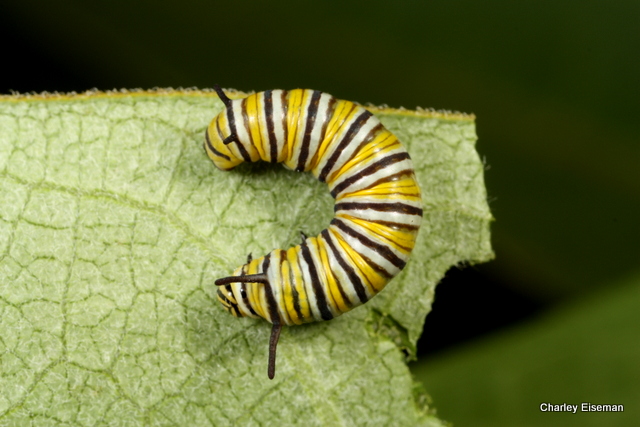
The monarch caterpillars continue to grow. One was missing yesterday (Sunday) and today I couldn’t find any of them. I suspect they went looking for a suitable place to pupate.

The asters are so striking that I couldn’t help but include them here, though I’ve already written about both smooth and New England asters.

Weekly Homestead Report 7: September 26, 2016

This was a very full week, with little time or energy for the garden or woods; however, as there was some chance of a frost Sunday night, Charley and I harvested all the ripe squash, tomatoes, and a lot of other veggies this weekend. We picked 19 butternut squash, about a dozen acorn squash, seven pie pumpkins, six spaghetti squash, and about 25 pounds of tomatoes, as well as a large quantity of ground cherries and a few pounds of tomatillos. We harvested all of the dry lima beans, and enough green ones for a meal. I also picked a bunch of herbs to dry or freeze. We’re still getting a few strawberries, as well as red and yellow raspberries.


Earlier in the week, we picked 13 pounds of grapes (a mix of our cultivated Concord grapes and wild fox grapes). We simmered, smashed, and strained them, but the juice is waiting in the refrigerator for me to have a couple of hours to make it into jelly!

I have been featuring a different aster each week. Over the weekend, I noticed that the New England Aster, Symphyotrichum novae-angliae, had begun to bloom. This particular plant is glorious, over five feet tall, has dark purple flowers with orange centers, and is loaded with buds. According to the excellent website GoBotany, New England asters are distinctive because they have “more ray flowers than other American-asters (45-100 per flower head).” They are also the deepest purple of the asters in our yard.

The monarch caterpillars we’ve been watching disappeared from the plants they’ve been feeding on early last week. However, we found three previously unnoticed caterpillars on a patch of milkweed on the other side of the garden this past weekend. They seem to be at a similar stage of development, almost two inches long, so we’ll follow these guys now. Mysteriously, the smallest of the three was resting on an ash leaf as if it were about to pupate.

Weekly Homestead Report 6: September 19, 2016

img_6096

I’ve been on Nantucket for most of the past week, so I’m relying on Charley to provide much of the fodder for this post. I work in the natural science museum at the Maria Mitchell Association; this week I had the honor of meeting our new Natural Science Director, Dr. Emily Goldstein, as well as seeing off my good friend and previous Director, Andrew Mckenna-Foster. Just before catching the ferry home this morning, I went out with them to check American Burying Beetle pitfall traps (evaluating a long-term reintroduction project). I’ll write more on that first insect love of mine another day, but that’s what is going on in the photos below. I’ve included photos of the endangered ABB (Nicrophorus americanus), as well as its more common cousins N. marginatus, N. orbicollis, and N. tomentosus. 

Anyway, before I left home on Wednesday, I finished blocking in the raised beds in the hoop house and planted some lettuce in the bed that I’d already filled with compost.

Charley has continued tracking the development of the monarch caterpillars that hatched last week. They’re getting bigger. We’ve also been seeing several fresh-looking adult monarchs on the butterfly bush and wildflowers in the yard.

img_1685-001

Both the wild fox grapes and our cultivated Concord grapes are ripening and smell delicious. I sense grape juice and jelly in our immediate future.

A bear left its calling card on the path between the chicken coop and the shed. It had obviously been enjoying the grapes as well. In fact, seeing this is what reminded Charley that it was time to check on the local grapes.

About once a week, we think we’re eating the last mulberry, but then we spot a green one. This time around, when Charley ate the one ripe mulberry, he discovered two additional flowers! I’d be surprised if these ripen before the frost, but we’ll see.

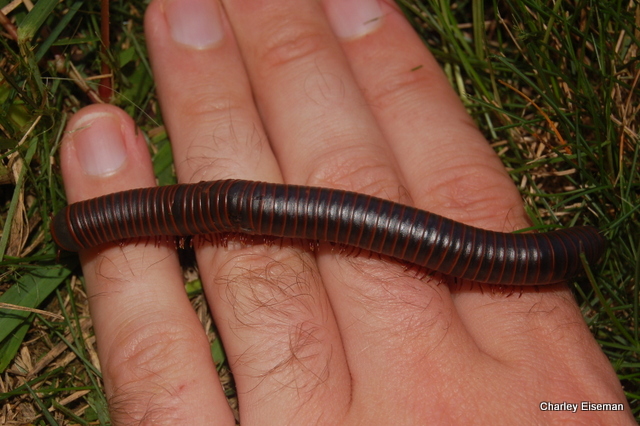
Charley also noticed this millipede while he was mowing some grass by the pawpaw patch. It’s a Narceus sp.  People often confuse millipedes and centipedes. Centipedes have just one pair of legs per segment and are somewhat flattened; millipedes have two pairs of legs per segment and a rounded body. (I remember that millipedes have more legs than centipedes because a million is more than a hundred).

dsc_2840

Charley found some other fun bugs munching on the birch in our woods on Friday morning. You can read about it and enjoy his fantastic photographs on BugTracks.

There are still lots of veggies in the garden. Charley picked an oddly deformed tomato, and I remembered that I’d found one like it a few weeks ago. I’m not sure what’s going on with these.

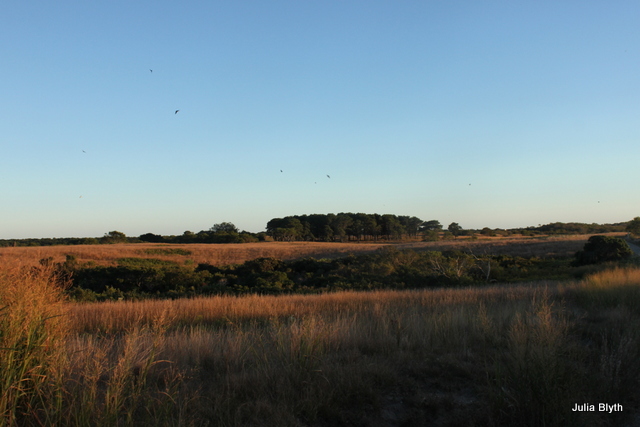
On Nantucket, in addition to preparing lots of birds as specimens for the museum, I had the opportunity to witness the beautiful spectacle of a tree swallow tornado. At dusk, around 50,000 swallows began swirling around our hilltop perch in Sanford Farm. They flew all around us in a disorganized flurry for about half an hour, wowing me with the sound of their wing beats as hundreds flew past at once.  Finally, when it was just too dark to get a decent photo, the whole flock rose up quite high above Hummock Pond, forming a murmuration like a school of fish that bent one direction, then another, and then down, down, in a ribbon to roost in the phragmites and cattails in the marsh. It was a graceful tornado, a ribbon with a curl. Finally, they were all down and out of sight. Less than a minute later, a strikingly large and orange full moon rose in the east.

The following day, about 20 birders walked out to witness the beautiful event together. David Policansky got some nice video footage. You may be able to view it here (on his Facebook page).

Weekly Homestead Report 5: Sept 12, 2016

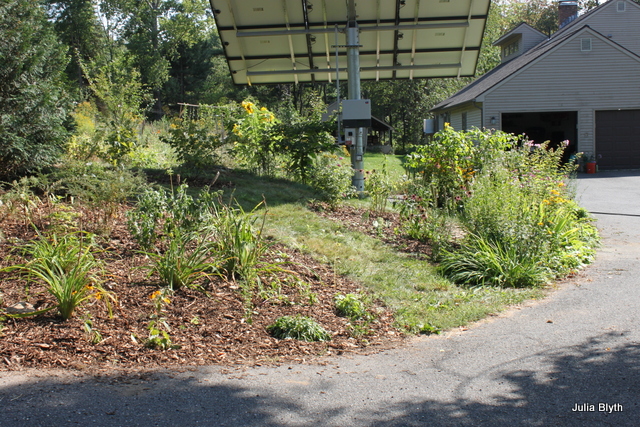
This week Hurricane (then Tropical Storm) Hermine  made its way up the coast. In Northfield, it manifested as two days of misty rain, high humidity, and relatively cool weather. I jumped on the opportunity to divide perennials and fill in the new flower beds by the driveway.  We got almost 3/4 of an inch of rain on Friday, and another half inch (along with serious wind and a little thunder) on Sunday, all of which should help the plants survive the uprooting.

img_5995-001

This is the season of being overwhelmed by the garden’s productivity, so I’ve been busy preserving it. I canned another batch of tomato sauce, a big batch of salsa verde (tomatillo base), and a ridiculous quantity of hot pepper jelly. Tomatoes are ripening faster than I can keep up with them, so we’ve been trying to give away a lot, too. We’re getting lots of cucumbers, ground cherries, tomatillos, peppers, squash, and eggplant. We picked another outstanding watermelon, and made our first pumpkin pie of the season. I’ve been collecting dry legume seeds; we’ll plant the peas in the hoop house this winter to eat the greens, and the black beans are just plain food. Charley brought the first bunch of delicious fox grapes home from work on Friday. A few more beach plums were ripe (one bush makes orange ones instead of purple, we learned yesterday), and we’re still getting strawberries. The raspberries are going strong.

Last week (Wed, Aug 31st), I saw a monarch lay her eggs on a milkweed plant, and posted Charley’s photo. Nine days later (Friday, Sept 9th) the eggs hatched into these tiny caterpillars! On the third day, one of them had molted into its second instar.

Eager to get things going in the hoop house, I started building the raised beds. This one bed will have the highest quality compost, since we have only produced a limited supply and need to use some of it in other parts of the garden.

Our soil is dramatically different across our property. This is well demonstrated by the size and vigor of kale planted on the same day in the “upper” and “lower” gardens, but perhaps best seen by comparing these sunflowers. They range from about three inches to eight feet tall, with flowers of less than an inch to over a foot in diameter.

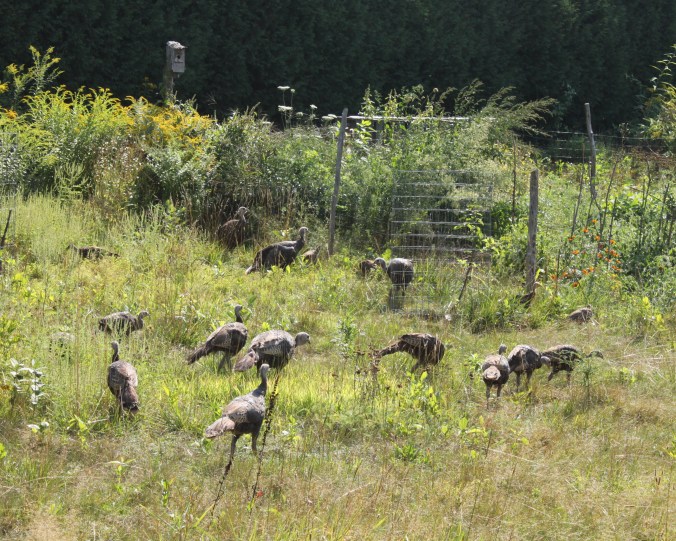
Having a “wild” yard means we get to see wildlife. On Friday a big flock of turkeys wandered through, eating grass seed and insects. I really enjoy their dinosaur-esq appearance, and I’m glad they’re not as damaging to the landscape as chickens (which seem to prefer bare dirt, and scratch the vegetation to death if allowed enough time). In the interest of full disclosure, this photo is from last year.

img_1304

I’ve been mentioning different asters blooming in each post; this week belongs to the Smooth Aster (Symphyotrichum laeve). This particular plant seeded itself in right by the corner of our driveway turn-around. It’s over four feet tall, although someone drove over it in June and many of the stems were broken off. It has re-sprouted, but the flowers on those younger stems aren’t yet open.

Several of the perennials that I grew from seed this spring started blooming. The verbena started almost a month ago, but the hyssop and balloon flower just opened up this morning! Some kind of hypenoptera (a cuckoo bee, I think) was sleeping in the hyssop when I went out to photograph it.

Weekly Homestead Report 4: Sept 5, 2016


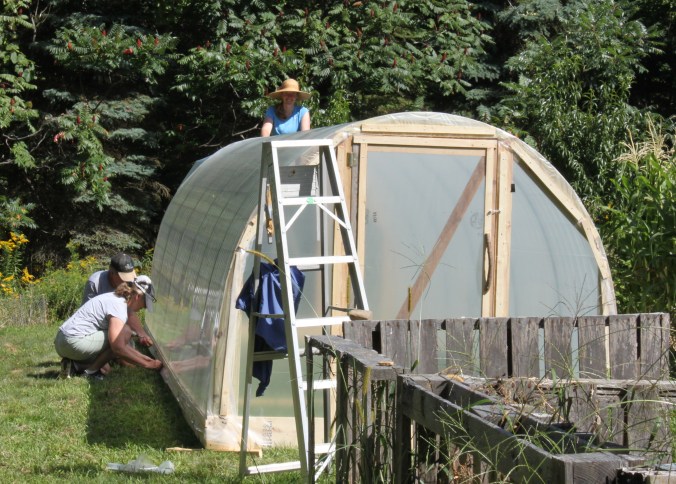
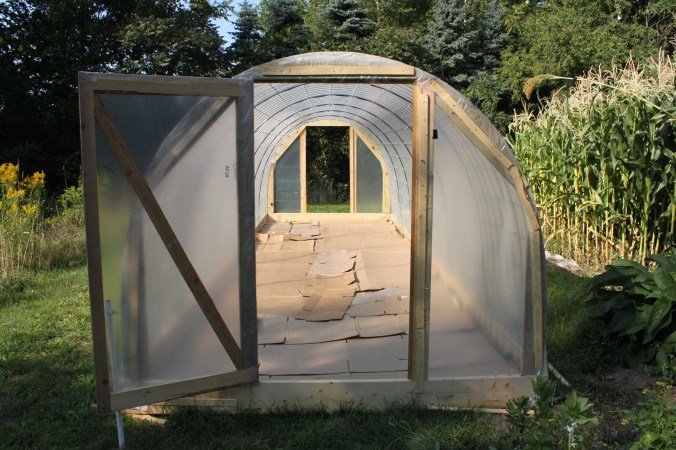
IMG_5826My parents, Charley, and I skinned the greenhouse and did a lot of the fiddly little finishing work on Tuesday. Then I picked up a bunch of cardboard by hanging around at the transfer station intercepting people with big boxes on their way to the recycling bins. I’m using it to smother the grass; hopefully in a year or so, both the sod and the cardboard will have turned into good soil, without us having to dig it up (a lot of work that would apparently disturb the good soil microbes). Now we just need to frame the raised beds and fill it up with compost and some seeds for this winter!

IMG_5931After getting to a stopping point with the hoop house, Dad went fishing while Mom and I picked about 8 pounds of Hungarian hot wax peppers and pickled them. We made 11 half pints and 4 pints of sweet hot peppers, and managed not to burn our hands or eyes with the pepper juice (gloves are essential for this operation). Thursday was another tomato day, with 4 jars of stewed whole tomatoes, and 9 more jars of sauce (a few jars thick enough for pizza sauce this time).

Wednesday, August 31, sometime while I was taking my parents to the airport, a grouse struck the fence of our chicken run, killing itself.

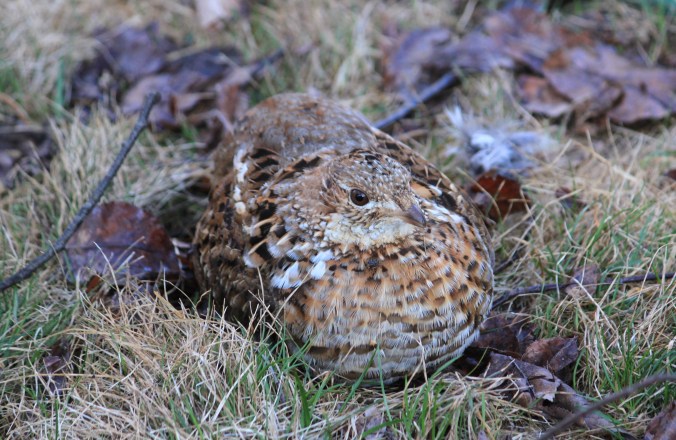
This is not the first grouse-smacking-chicken-pen incident at our house, but it is the first that ended with a death. Last April a grouse hen flew into the closed shed door while I was in there getting food for the chickens, which was quite alarming for both of us. She sat, dazed, on the ground for long enough for me to take some pictures. When Charley opened the door a while later, unaware of the event, she spooked and flew into the side of the chicken fence, then veered off into the woods.

IMG_9810Later that summer, we found a grouse-sized dust bath, complete with a feather, under our rhubarb patch. This year, we have routinely flushed a family of at least five grouse from our blackberry patch, and recently found another dust bath sufficiently large for the whole family on the dirt among the roots of an upturned tree.

IMG_5877I suspect this bird was one of those. It is always very sad to find that our human infrastructure has caused the death of an animal, but around here, we try hard not to waste food, especially meat. I don’t usually photograph my dinner plate, but the “chicken” vindaloo with fresh tomatoes and onions was mighty fine.

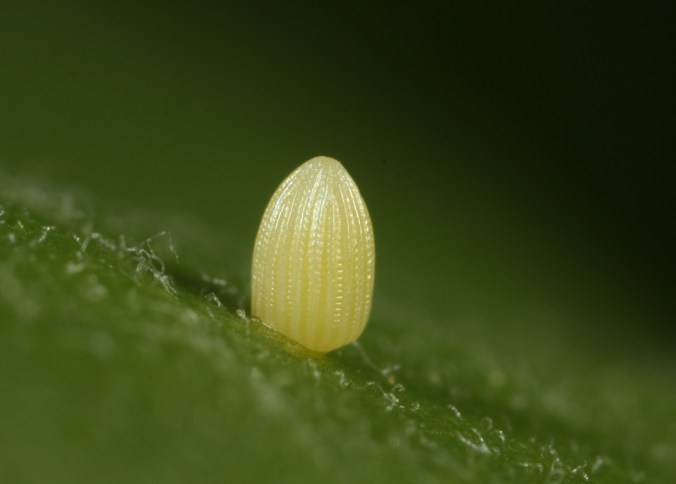
Wednesday was an interesting day for another reason, too. Just after finding the dead grouse, I spotted an adult monarch butterfly. She fluttered over the garden and laid several of the distinctive ribbed yellowish eggs on a small patch of milkweed. Charley took some closeups of the eggs (it’s his photo below), and we’ve been checking them every day so we can record how long it takes them to hatch, and photograph the young caterpillars.IMG_0214In the yard, lobelia is blooming, and the red maples are just starting to turn reddish-orange, but most of the woods still look green. We found some mating ambush bugs hanging out with a dead cabbage white butterfly in the woods today.  We’ve been chasing the little buggers around the yard with nets, trying to feed them to the chickens before their caterpillars finish decimating the brassicas, so it was nice to find an ally.

We ate our first ripe watermelon of the season and a few beach plums, as well as an abundance of ground cherries, tomatoes, tomatillos, peppers, squash, beans, etc. We probably ate the last of the corn, though maybe there are a few ears yet to be found.

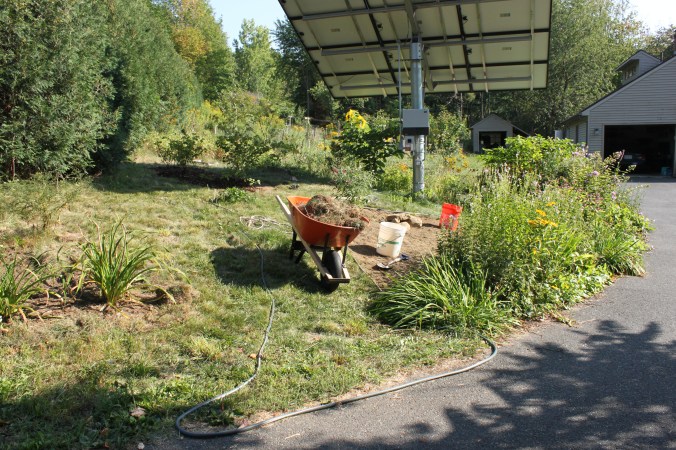
This weekend we started digging an expansion of our perennial bed by the driveway/ solar panel area. It has been a week of unbridled productivity due to the pleasant weather and my computer not being around (it got some kind of virus and had to take a trip to the neighborhood computer-repair guy).

IMG_5927.JPGI suppose it won’t look like much until next summer, but I’m excited to get it all planted and mulched in the next week or so.

Weekly Homestead Report 3: Aug 29, 2016

There are two bits of exciting news this week: we found that our rock garden isn’t a complete failure, and we started construction of a hoop house!

When we dug up parts of the lawn for our vegetable garden about two and a half years ago, you could see the four rock piles on satellite imagery (just below the rectangular beds, from Google Maps).

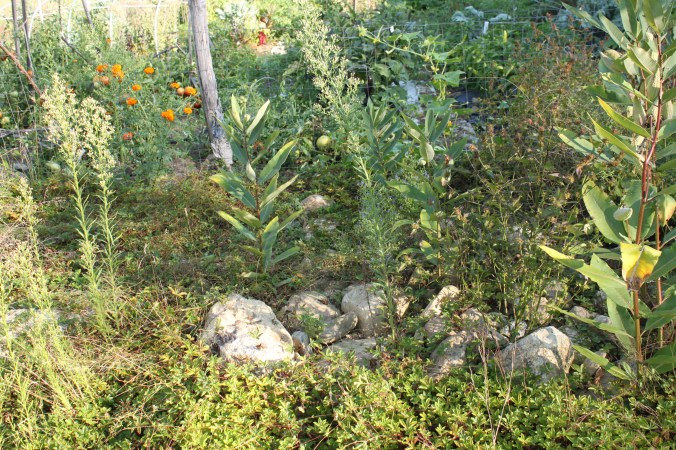
After using some of the rocks for the floor of an outdoor shower, to level off the road edge by the mailbox, as steps down from the driveway to the “lower garden,” and other projects, there were still lots of rocks left. We decided to spread them out and fill in the spaces with dirt and sand, and then sprinkle in some seeds we collected from open sandy habitats. Crickets quickly moved in and made homes in the miniature caves. This spring, we neglected the rock garden and it became covered with cinquefoil, horseweed, and milkweed.

IMG_5591.JPG

On Tuesday when I was weeding the cucumbers just on the other side of the fence from the rock garden, I discovered a funny-looking plant, something I was pretty sure was a sandplain specialist. Sure enough, Charley identified it as orange-grass St. John’s-wort, or Hypericum gentianoides, a plant of rocky ridges and grasslands, especially disturbed habitats like the sand pit created by four-wheelers where we’d collected the seeds. The plant has tiny (practically nonexistent) upright leaves, small yellow flowers, and orange-red fruits.

When Charley came out to see the St. John’s-wort, he looked over the fence at the rock garden and spotted what I had somehow missed—blooming bluecurls! Forked bluecurls, or Trichostema dichotomum, is appropriately named, as it is blueish-purple with two long curved (curled) stamens that would clearly get pollen all over the back of a bee. Like the St.John’s-wort, this is a grassland plant that readily colonizes disturbed places. I had never seen the flowers before, but the dried stems and seedpods were charming when we collected them last fall. Each plant is about one foot tall with dozens of flowers that open each morning and wilt by mid-afternoon.

I decided to pull out the cinquefoil and horseweed to see if any of the other rock/ sand specialists had sprouted. I got about 3/4 done when a couple of irritated paper wasps came over to let me know that I was disturbing their nest. I left. Lucky for me, we’ve had a few skunks hanging around. We’ve seen them in the driveway at night, and gotten a few photos on the wildlife camera. Skunks really like munching grubs, and don’t seem to mind a few stings if that’s what it takes. Two days after I abandoned the weeding project, a skunk (I presume) had pulled a few rocks out of the way and ripped the nest out, devouring the grubs, and digging out some of the dirt. There are still a few unhappy adults around, but now that the nest is gone, I can probably get on with weeding without getting stung.

There is purple-stemmed aster (Symphyotrichum puniceum) growing out of the pavers in our patio under the deck. It started blooming this week. That makes aster #3, after the white wood aster and calico aster.

IMG_5617

In our woods  blooming plants include: virgin’s bower (Clematis virginiana), monkeyflower (Mimulus ringens), meadowsweet (Spiraea alba), Canada goldenrod (Solidago canadensis), boneset (Eupatorium perfoliatum), Indian tobacco (Lobelia inflata),  jewelweed (Impatiens capensis), willow-herb (Epilobium), and white turtlehead (Chelone glabra). Our cultivated pink turtlehead just started blooming by the driveway, too.  Additionally, in the powerline cut behind our woods, we found blooming joe-pye weed (Eutrochium maculatum), purple milkwort (Polygala sanguinea), gerardia (Agalinis), rattlesnake root (Prenanthes trifoliata), and flat-topped aster (Doellingeria umbellata).

I find it fascinating to watch bumble bees collecting pollen from the turtlehead. They pry open the lips of the flower, squeeze inside, back out after about 5 seconds of buzzing, and briefly attend to collecting the pollen from their furry parts and transferring it into the pollen baskets on their hind legs before heading to the next one.

We’re pretty much eating the same things as last week. This is the time when the garden swamps us with its abundance. There are so many tomatoes!  I picked 32 pounds on Friday and made 12 pints of tomato sauce, and that’s in addition to dehydrating all the ripe cherry tomatoes on Tuesday (now they fit into a one quart bag).

And now, the hoop house! My parents are visiting from Ohio. My dad is a remodeling contractor and someone who doesn’t relax much. My mom is an avid gardener and food preservationist. They recently built a hoop house using hog panels (4′ by 16′ stiff welded wire fence), and had such a great time eating salad all winter that I wanted one too… So before they came, I measured my space and gathered up materials. Because of the way it is constructed, with the 16′ hog panels creating the arc, it can only be about 7-8 feet wide if you want to be able to stand up inside. We decided to use 6 panels for a 25 foot length. I also bought six long 2 x 8s for the box at the bottom, some 5/4 decking material to build the ends, and some hardware. I’m sorry I didn’t take a photo of the little-Honda-Civic-that-could hauling everything from the lumberyard, because it was impressive! This is a great experimental greenhouse, because the materials cost just $426, and two of us built the entire frame in less than 6 hours yesterday. Today we built and hung the doors and put plastic on the two ends. Tomorrow we’ll “skin” the main part.

The hoop house is currently oriented with the long sides oriented east-west, mostly because our corn patch is in the way of where we wanted to put it, oriented with a long side facing south… BUT, according to the New Mexico Extension website: “For maximum passive warming in the winter months, consider orienting your hoop house so the long side runs east/west.” Okay, done! I think leaving it where it is sounds much better.

Weekly Homestead Report 2: Aug 22, 2016

First, a note to my email subscribers: the formatting will be much better, and the photographs larger, if you click on the link and read the blog online rather than in your email program. I think I’ve set it up so your email will be a summary with a button that will link you to the blog, but since I’m new at this, I’m not sure. Now, on to the week’s news!

~     ~     ~     ~    ~    ~

This is a week of beautiful caterpillars.

Over the last three years, we have converted a sterile lawn into habitat-rich orchard, vegetable garden, and meadow. The meadow has grown simply by not mowing regularly, and selectively mowing around desirable plants to promote them and suppress the prolific non-native invaders. The meadow and flower beds now include several large stands of common milkweed, lots of goldenrod and asters, a sea of Queen Anne’s lace, and some native shrubs—like spicebush.

Last week I posted a picture of a spicebush swallowtail caterpillar. This week, you can enjoy a younger instar. It has cleverly disguised itself as a bird dropping with eyes. All instars have pretty convincing false eyespots. The caterpillar’s actual head is tiny and tucked down, making it difficult to see its true eyes, and I suppose the guise works to persuade potential predators that it is actually a snake or something much fiercer than a caterpillar.

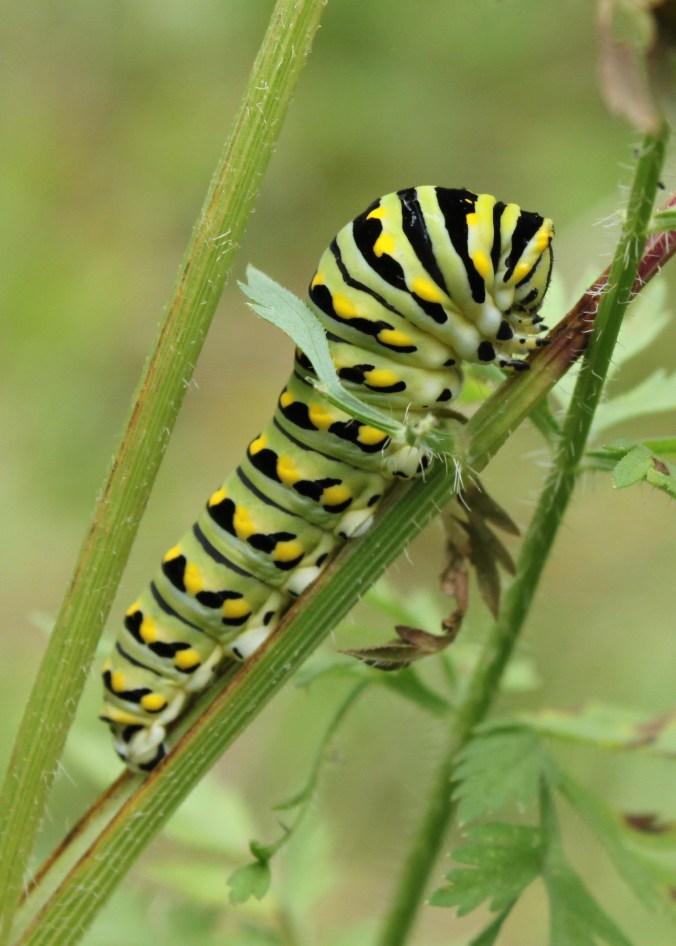
Queen Anne’s lace is in the parsley/carrot family, so native insects associated with this family are happy to eat this non-native plant. Just yesterday, we spotted a black swallowtail caterpillar. Last year, we found a few eating our cultivated carrots, and transferred them over to the Queen Anne’s lace. This one had found the Queen Anne’s lace on its own.
IMG_5209

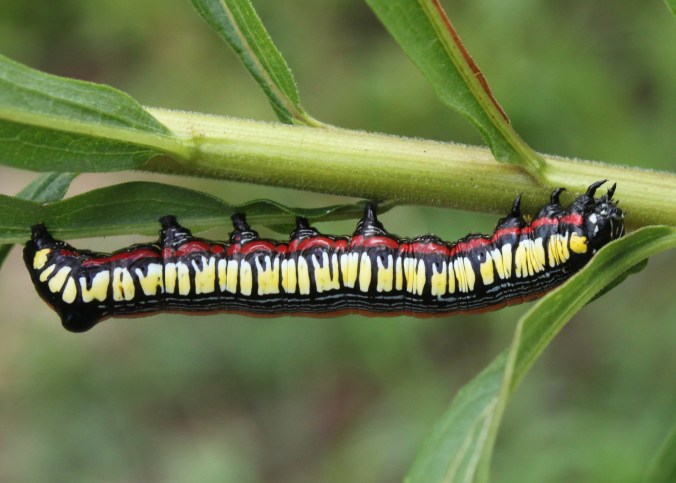
Sometimes, very bland moths are very beautiful as caterpillars. Brown hooded owlet moth caterpillars certainly fall into this category. The caterpillars eat goldenrod and asters, so they’re happy in our yard!
IMG_5151

In the past, we have noticed milkweed beetles and milkweed bugs, but this week, for the first time ever, we spotted a monarch caterpillar! As is broadly known, monarchs are in decline for a number of reasons, including increased pesticide use and decreased habitat (farmers eliminating “weedy” hedgerows to maximize crop area). We have only one record of an adult monarch in our yard, on September 29, 2015. Obviously there must have been one in our yard a couple weeks ago, too, in order to lay the egg! We also spotted a milkweed tussock moth caterpillar and fall webworm eating milkweed.

Aside from caterpillars, we’ve been enjoying some great wildflowers. By the chicken house, the native sunflowers that we yanked up from the gravelly shoulder of the road near Charley’s parents’ house are blooming.  It was a patch he’d been admiring for most of his life, and when we noticed that they’d spread into the path of the highway department’s mower, we decided to transplant a few of the most at-risk. In the two years since then, they’ve spread wonderfully. Yesterday I photographed bumblebees, hover flies, a crab spider, and even a dance fly hanging out on them. Hover flies are bee mimics, reminding me of sweat bees, and while they do sometimes hang around sweaty people, even lapping moisture off of us with their sponge-like tongue, they are truly flies. They are in the family Syrphidae; many syrphid larvae eat aphids, and therefore are important biocontrols for farmers and gardeners.

In the woods, hog-peanut, common boneset, and white wood aster have started blooming. White wood aster is one of the most abundant woodland plants in New England, and its sweet white flowers brighten up the woods in late summer. At least on our land, they are the first of the asters to bloom (although we spotted the first calico aster bloom today, just a few days after the white wood aster).

In the garden, we’re picking an abundance of corn, tomatoes, peppers, cucumbers, summer squash, and eggplant. I’ve been canning. In the photos below, the really tall plant behind Charley is broom corn.

We’re finishing the last of the black currants and gooseberries, and are still enjoying ever-bearing strawberries. The ground cherries (or husk cherries) are just starting to ripen, and they are delicious! Ground cherries are native nightshades (the family that contains tomatoes, potatoes, peppers, and eggplant). The fruits, like those of tomatillos, are “wrapped” in a papery husk (a modified calyx). The fruit falls off the plant and finishes ripening on the ground; the husk turns brownish and crinkly when the fruit is ripe. Unwrapped, the fruits look like golden tomatoes, but taste sweeter and less acidic (Charley says, “like creamsicles”). Last year we dried some, creating unusually delicious raisins. So far this year, none have made it beyond the garden fence.

In other news, we acquired two additional hens on Wednesday. These girls showed signs of scaly leg mite, and even though their previous owner said they’d been treated, we decided to give them another leg-drenching and a 24-hour quarantine before introducing them to the rest of the flock. They’re still a bit shy with us and the other chickens, but I’m confident that they’ll fit in soon.

Weekly Homestead Report 1: Aug 15, 2016

My intention with this blog is to write once a week about biological and other happenings at our little homestead on Crag Mountain. This will serve as a reminder for Charley and me to slow down and take stock of what is sprouting or blooming, what creatures (bugs especially, of course!) we’ve noticed, and what we’re eating out of the garden and woods.  Assuming I am properly diligent, we can know what to expect in future years, and document any phenological changes from year to year.  It’s also an excuse to spend some time taking photos of beautiful things. In addition to close-ups of creatures mentioned, I intend to post pictures of certain parts of our yard repeatedly, so we have a log of changes over the seasons.
Solar panel flower garden in April, June, and August.

Back, or down-hill garden on July 7 and today (August 15).

~      ~      ~      ~      ~

As anyone living in the New England knows, we’ve had a significant drought over the last two months. This week we finally got some rain, but the garden still looks tired (like I feel in the heavy humidity). Nonetheless, the yard is thick with Queen Anne’s lace flowers, the Canada goldenrod is just starting to bloom, and milkweed pods are swelling.

In the woods, monkeyflower (Mimulus ringens) is blooming.  We found a stem mining fly in the monkeyflower in our woods just two days before it emerged—the fly, or at least its life history, is unknown to science, so Charley will send it off to a taxonomist now that we have reared the adult.  You can read more about our (especially Charley’s) bug adventures at his blog, bugtracks.

One of my least-favorite plants, tearthumb, or Polygonum sagittatum, is also blooming in the woods. It sprawls across the ground, tearing not just thumbs, but also legs and any other tender bit of skin that it touches. Our woods was logged 4-5 years ago, and tearthumb is an early colonizer of seepy places with some sun.

On the garden fence, groundnut (Aprios americana) is blooming spectacularly. Groundnut is a native legume with delicious edible tubers, so we’ve encouraged it to spread.

In the garden, we’re picking sweet corn (sweet ambrosia), the first of the tomatoes, bush and pole beans, zucchini and yellow crookneck summer squash, eggplant, peppers, chard, broccoli, and kale. We’re still harvesting the ever-bearing strawberries, and ate the penultimate mulberry yesterday (it’s only a two year old tree, so we’re thrilled to have gotten about 15 berries).  Also yesterday, we ate the first two ground cherries of the year.  Around the county, blueberries have been ripening for almost a month, but up here on the mountain, we’re just picking the first both wild and cultivated blueberries this week. Our cultivated beach plums are starting to turn.

I almost forgot to mention the wild blackberries, though they are the highlight of the week! The patch is in full swing. I picked 3 quarts easily in about an hour, and made blackberry jam (strained this year, so we wouldn’t have to crunch through so many seeds). Last year a bear crashed some helpful paths through the prickly patch… no such luck yet this year, but I’m setting the motion camera out in the berry patch today just in case. At the least, we might get a photo of the grouse family that we keep flushing.

We’re still picking an abundance of Japanese beetles off of the cherry trees, grapes, evening primrose, and raspberries, even though it seemed like they had slowed down last week. We pluck them into a container of soapy water and dump it in the chicken yard; the hens gobble them up in seconds flat. There have also been some red-humped caterpillars (Schizura concinna), a species of notodontid (moth) whose caterpillars devour leaves of apples, cherries, and in our case, plums. They go to the chickens too, but sometimes Charley is nice and moves them to a wild cherry at the edge of the woods. This week we’ve noticed lots of grasshoppers and the first evening feeding swarms of Aeshna (Darner) dragonflies.  Spicebush swallowtail caterpillars have been folding the leaves of the spicebush we  planted by the front of the house.

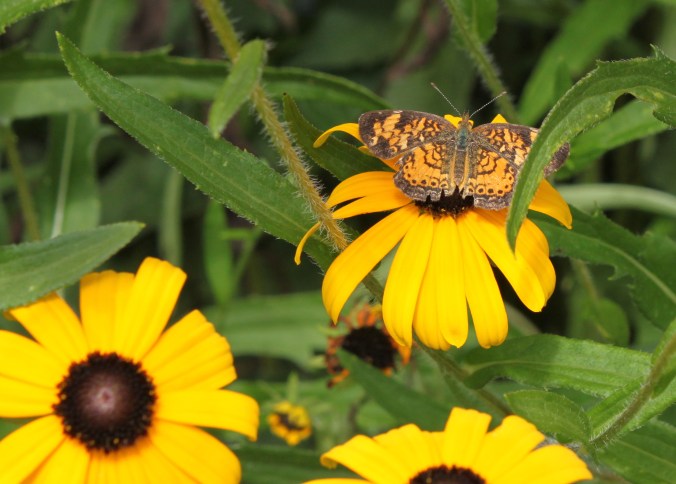
In the flowerbeds, purple coneflower and black-eyed Susans are blooming, and covered in pearl/ northern crescents (Phycoides sp).

IMG_4903

In the mega-fauna category (comparatively, anyway), we’ve been hearing a family of Barred Owls, the young making a very peculiar sound as their parents school them on proper hooting. Yesterday we saw an American Robin take the first real bath that we’ve witnessed in our birdbath. Its three puffy fledglings looked on from the grass as it splashed in the water and shook its feathers dry.  I haven’t managed a photo yet, but I’ve been seeing a young porcupine ambling along in the woods, and tonight, there was one sitting in the middle of the road. Two days ago, coming home in the dark, we had to physically remove two American Toads from the driveway before driving up it to avoid squashing them. Since the rain a few days ago, I’ve noticed at least a dozen young pickerel frogs jumping out from underfoot as I walked through the dewy morning grass.  Below, you can see one hiding under the rhubarb shot through a hole in the leaf.

I can’t wait to see what new things this week has to offer!