I have not kept up with my so-called weekly reports, but it is not because of a lack of things to report. January and February brought snow and mammal tracks to look at, fiber arts, and writing projects; by March we were already well into a month-long excursion to the desert of California, from which we just returned.

Our trip took us first to my parents’ house in central Ohio, where spring was already well underway on Feb 21st. The vernal pool was full of chorusing wood frogs and salamander eggs. The first of the spring ephemeral wildflowers, harbinger of spring (Erigenia bulbosa), was up and blooming.

Dad and Charley look for invertebrates in the vernal pool

wood frogs get counted in a basin

wood frog portrait

wood frogs pose after being released

harbinger of spring
The next big stop was in New Mexico, where we toured Gila Cliff Dwellings National Monument. I love the sense of standing on ground where people made their homes hundreds of years ago. Pictured below are some of the dwellings (a series of 6 caves contains around 40 rooms) and pictographs from a few miles down the road. Near the pictographs was a single cave with three rooms. The wood over the entrance contained evidence of bark beetles over 600 years old.

Gila Cliff Dwellings National Monument

pictographs

sign of bark beetles
Wanting to escape the chilly air in New Mexico and fulfill the mission of the trip (finding leaf-mining insects in the desert), we headed into the glorious canyons of southeastern Arizona. We camped in Cave Creek Canyon and Millers Canyon, and explored a Nature Conservancy property in Ramsey Canyon. Each canyon feels quite different, but all are lush with birds, plants, naturalists, good hiking, and insect mysteries solved or discovered.

Cave Creek Canyon

Cave Creek Canyon

Cave Creek Canyon

Cave Creek Canyon

Cave Creek Canyon campsite

Ramsey Canyon; agave weevil

Millers Canyon, kitchen set-up

Millers; Hepatic Tanager female

Millers; Hepatic Tanager male

Millers Canyon sunset
To get a sense of the Sonoran Desert surrounding these canyons, we decided to go to Saguaro National Park, where everything seems thorny! The curve-billed thrashers, mockingbirds, cactus wrens, and Gila woodpeckers were abundant and noisy, and we glimpsed a trio of shy Gambel’s quail.
After Tucson, we headed north to meet up with our friend Eric LoPresti near in the Tonto National Forest near Phoenix. A fellow bug-hunter, he proved a valuable asset by spotting leaf-miners, driving us to inaccessible places in a four-wheel drive high-clearance truck, cooking countless meals with us, and convincing us to come on the trip in the first place.

wildflowers protected from grazers by cacti

blue dicks (Dichelostemma capitatum)

mustard

poppy

Bucculatrix enceliae cocoon on brittlebush

blue dicks
After finding several leafminers likely unknown to science, we caravaned through the strange town of Blythe into the California desert, camping in a bizarre moonscape near a military gunnery range in the Chocolate Mountains. The area looked blasted (more likely by OHVs than missiles) and had very little vegetation—but we found locally abundant teensy moths on desert ironwood (Olneya tesota).

Prius/ tent combo in the CA desert

Eric’s 4-runner with our Prius
A stop in the Algodones Dunes got us into a whole new set of plants, and a whole new bizarre landscape, which seemed like it didn’t belong so far inland. We encountered one of Eric’s favorite plants, Abronia (sand-verbena, a pretty purple flower), for the first time. He studies insect herbivory and plant defenses at UC Davis, and his normal high level of enthusiasm would increase to animated shouts whenever he saw a plant so sticky that it became covered with sand.

roadrunner tracks

Abronia

Charley among the evening primrose

Desert Lily

Charley and Eric
Our next stop was Shell Canyon, near the town of Ocotillo. We ambled through the wildflowers beneath a bunch of wind turbines for an hour or so, then drove to the end of a very rough road into a slot canyon to camp. White-fronted swifts (Cypseloides storeri) were feeding nestlings on the cliff wall.

wind turbines

slot canyon

evening primrose

Phacelia
Then, finally, we reached our destination and turn-around point: Anza-Borrego State Park, which was also the destination of everyone who watches ABC or CNN or reads the Washington Post; there had been extensive coverage of the super-bloom the previous week. We encountered the flowers pictured below in the southwestern edge of the park along the road and near the Bow Willow campground.

Lupine, poppies, and monkeyflower

Diplacus bigelovii (formerly Mimulus)

Lupine, poppies, and monkeyflower

Charley among cacti

jackrabbit

Amsinckia
We stayed at a University of California field station near Borrego Springs, where we met up with other entomologists and took day trips out to search for bugs (and enjoy the flowers). We saw “flower alley” in Coyote Canyon, which was full of tourists, and much farther up the canyon was a stream with running water and willows. There was also quiet, lovely Tubb Canyon, on an impossible road, and we drove into the desolate Wind Canyon and hiked out to see the Elephant Trees.

Tubb Canyon; Ocotillo in bloom

Coyote Canyon

Coyote Canyon

Coyote Canyon; Abronia

Coyote Canyon

Coyote Canyon, willow and baccarus

Tubb Canyon

Coyote Canyon; dry mud

Tubb Canyon

Tubb Canyon; barrel cactus and ocotillo

Elephant Trees trail

Elephant Trees trail

Tubb Canyon, brittle bush and jojoba
The most spectacular place was called Hawk Canyon; we first got there taking a trail to “The Slot” and then clambering down into the canyon, which turned out to be full of lupines and evening primroses.

Looking down on Hawk Canyon

Picking our way into Hawk Canyon

Lupine in Hawk Canyon

Charley and the lupine

Hawk Canyon

Hawk Canyon lupine and evening primrose
Heading home, we couldn’t resist stopping at Madera Canyon (just south of Tucson, AZ), which is one of my favorite places in the world. We stayed there for several days in November on our first big road trip in 2012; this time we didn’t have the campground to ourselves (in fact, the campground was full and we had to camp out in the open range with a bunch of cows), but we met up with a friend from college and hiked up to an old mine and on the little streamside nature trail, plus we found plenty of interesting birds and bugs.

Yellow-eyed Junco

Ruby-crowned kinglet

Mexican Jay

Madara nature trail

Sunset at Madera canyon

calves

leafhopper
Last stop: a 5000-acre ranch owned by a moth enthusiast in southern Texas. We found so many great leafminers there that I forgot to take pictures!
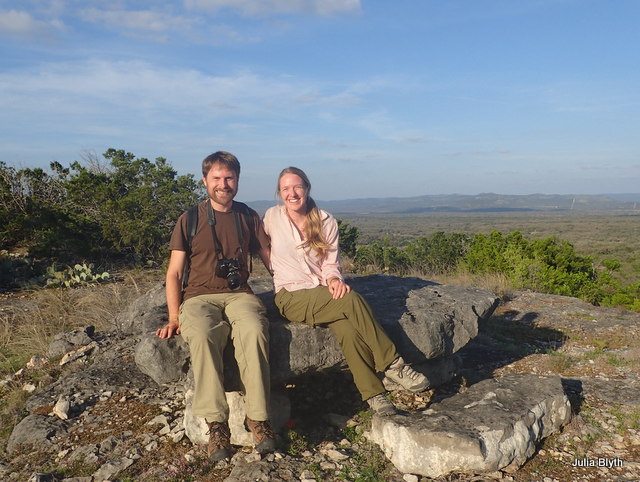
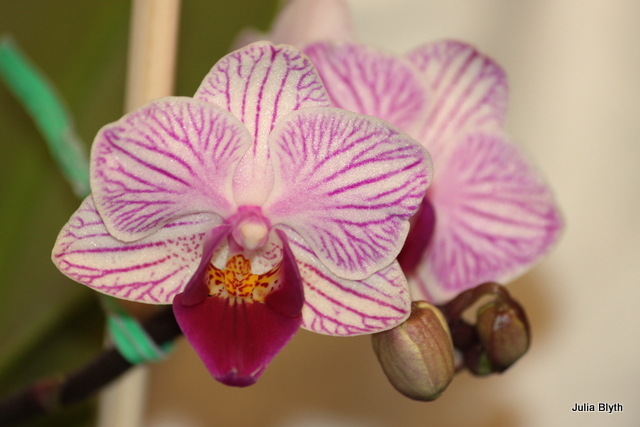
On the way home we slept in the Mark Twain National Forest in Missouri, saw my sister in Ohio for her birthday, and made it home in time for a selectboard meeting. Back in Massachusetts, we found a foot of snow and a partially collapsed greenhouse, but also a nicely plowed driveway, happy chickens, intact pipes, and blooming orchids.


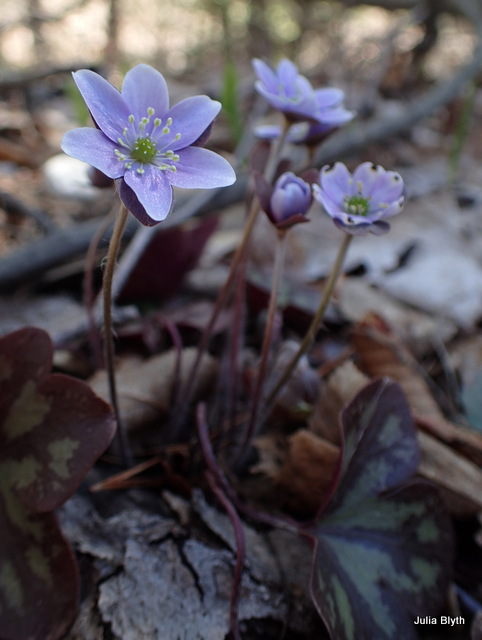


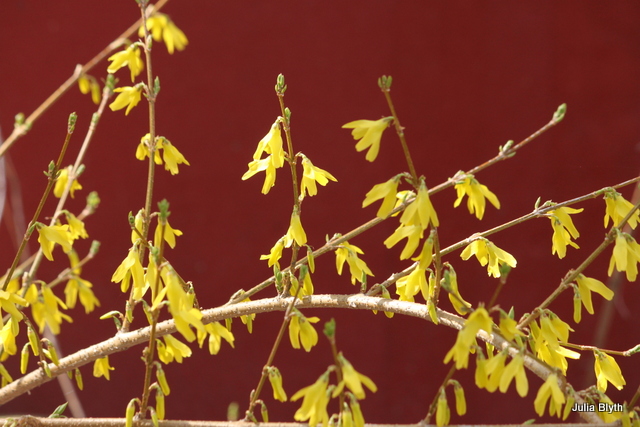


 We’ve been listing dates of our first sighting of each spring migrant: red-winged blackbirds on March 26; song sparrow arrived on April 1 at our feeder (10 days after last year’s first arrival); phoebe on April 4th; yellow-bellied sapsuckers drumming on April 10; tree swallows and eastern bluebirds on April 11 (and both species already in and out of several nest boxes); chipping sparrow and northern flicker on April 12. There are other birds around of whom we haven’t taken such careful note. We are still seeing juncos today, but fewer and fewer. It’s hard to take note of someone’s “last day.”
























 Julia Blyth